> ## Documentation Index
> Fetch the complete documentation index at: https://docs.iqrush.ai/llms.txt
> Use this file to discover all available pages before exploring further.
# Manage project settings
> Select Project settings, the gear beside Runs, to review the project’s configuration.
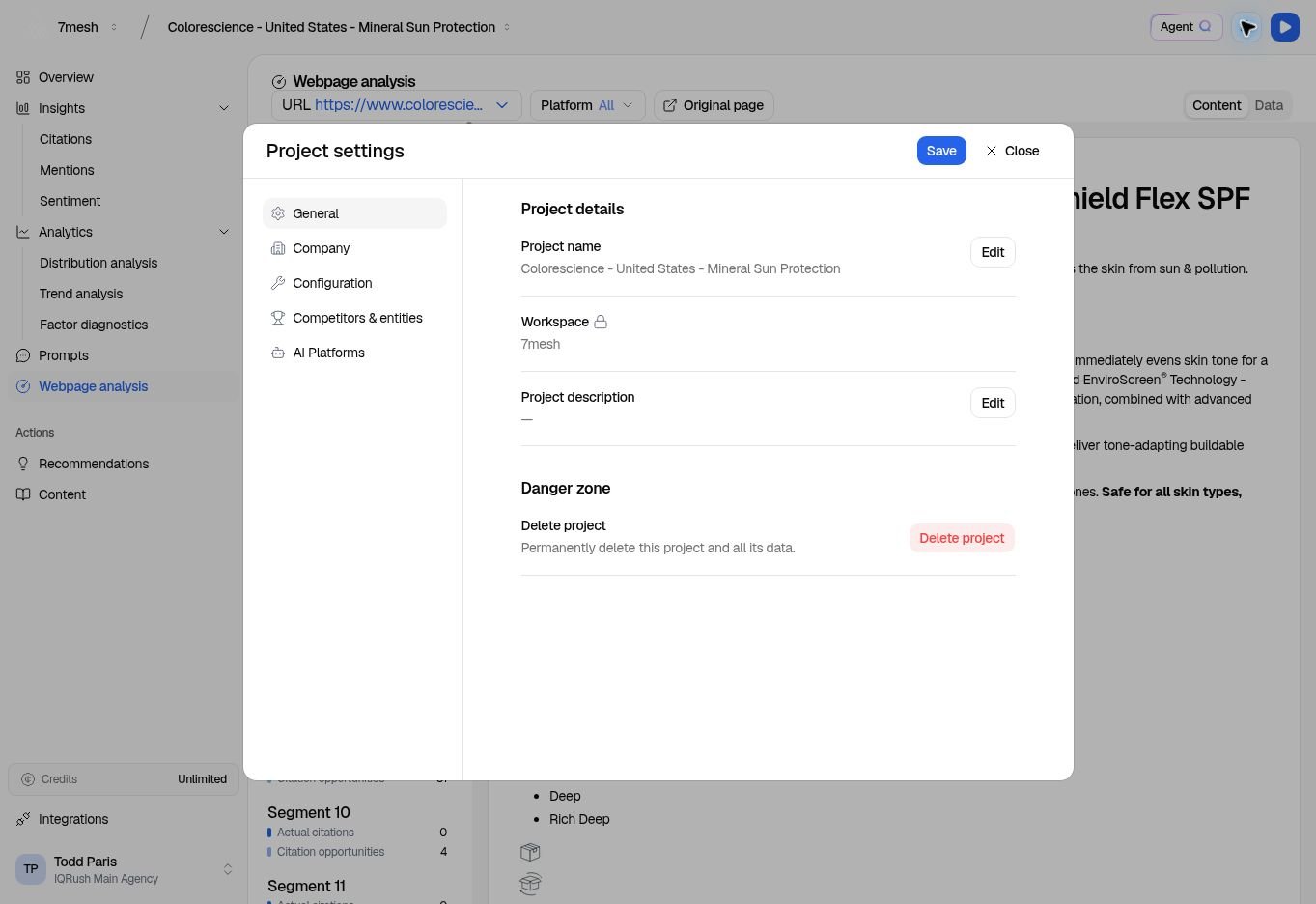
Select **Project settings**, the gear beside Runs, to review the project’s configuration.
 ## Know which setting to open
| Section | What it contains |
| - | - |
| **General** | Project name, workspace, and project description. |
| **Company** | **Company name** and **What the company does**. |
| **Configuration** | The established topics, brand terms, and domains. |
| **Competitors & entities** | Competitor and entity settings available for the project. |
| **AI Platforms** | The engines available for the project’s runs. |
## Change descriptive information
In **General**, select **Edit** beside **Project name** or **Project description**. Make the change, then use that row’s **Save**.
The **Workspace** is locked. Choose the intended workspace when creating a project.
In **Company**, review **Company name** and **What the company does**. Use **Edit** and **Save** to correct them when you have permission. The Company information is used by the **Brand Fit** check in Content Readiness, so describe the business accurately and concretely.
## Understand the locked configuration
**Configuration** is locked to preserve comparison across runs. The page provides **Create a new project** links when you need different topics, brand terms, or pages.
Use a new project for a genuinely different measurement scope. Renaming a project does not change what it measures.
## Manage competitors and entities
Open **Competitors & entities**. Review **Tracked competitors** and any **Added competitors**, then select **Manage** under **Manage project entities** to work with the entity list.
Use **Included**, **Excluded**, and **Show** to review the current list. **Add** starts the flow for another entity. Review the information and any preview offered before confirming it. **Exclude** removes an entity from the project’s displayed results for everyone using the project; it is not just a temporary filter for your own view. Use **Include** in the **Excluded** list to restore an entity when appropriate.
Follow the confirmation and save behavior of the entity control you use. These controls save their changes directly; the settings header’s **Save** is not an extra confirmation for them. Adding an entity is separate from changing the locked **Brand terms** that define the project’s target brand.
## Save an AI-platform change
After changing **AI Platforms**, select **Save** at the top. The **Save changes?** dialog lets you choose:
* **Save** to keep the change for a later run.
* **Save and re-run** to save it and start a new measurement, subject to the displayed credit requirement.
A settings change does not rewrite the answers already collected in an earlier run. Entity inclusion changes can affect how results are displayed, so keep the scope consistent when comparing or sharing a finding.
## About deletion
**Delete project** is in the General section’s **Danger zone**. The interface describes it as permanent deletion of the project and its data. Do not use it to reset a filter or change the project’s topics.
**Next:** [Manage runs](/guides/05-runs-and-schedules) or [create a separate project](/guides/02-create-project).
This documentation is built and hosted on [Mintlify](https://mintlify.com), a developer documentation platform.
## Know which setting to open
| Section | What it contains |
| - | - |
| **General** | Project name, workspace, and project description. |
| **Company** | **Company name** and **What the company does**. |
| **Configuration** | The established topics, brand terms, and domains. |
| **Competitors & entities** | Competitor and entity settings available for the project. |
| **AI Platforms** | The engines available for the project’s runs. |
## Change descriptive information
In **General**, select **Edit** beside **Project name** or **Project description**. Make the change, then use that row’s **Save**.
The **Workspace** is locked. Choose the intended workspace when creating a project.
In **Company**, review **Company name** and **What the company does**. Use **Edit** and **Save** to correct them when you have permission. The Company information is used by the **Brand Fit** check in Content Readiness, so describe the business accurately and concretely.
## Understand the locked configuration
**Configuration** is locked to preserve comparison across runs. The page provides **Create a new project** links when you need different topics, brand terms, or pages.
Use a new project for a genuinely different measurement scope. Renaming a project does not change what it measures.
## Manage competitors and entities
Open **Competitors & entities**. Review **Tracked competitors** and any **Added competitors**, then select **Manage** under **Manage project entities** to work with the entity list.
Use **Included**, **Excluded**, and **Show** to review the current list. **Add** starts the flow for another entity. Review the information and any preview offered before confirming it. **Exclude** removes an entity from the project’s displayed results for everyone using the project; it is not just a temporary filter for your own view. Use **Include** in the **Excluded** list to restore an entity when appropriate.
Follow the confirmation and save behavior of the entity control you use. These controls save their changes directly; the settings header’s **Save** is not an extra confirmation for them. Adding an entity is separate from changing the locked **Brand terms** that define the project’s target brand.
## Save an AI-platform change
After changing **AI Platforms**, select **Save** at the top. The **Save changes?** dialog lets you choose:
* **Save** to keep the change for a later run.
* **Save and re-run** to save it and start a new measurement, subject to the displayed credit requirement.
A settings change does not rewrite the answers already collected in an earlier run. Entity inclusion changes can affect how results are displayed, so keep the scope consistent when comparing or sharing a finding.
## About deletion
**Delete project** is in the General section’s **Danger zone**. The interface describes it as permanent deletion of the project and its data. Do not use it to reset a filter or change the project’s topics.
**Next:** [Manage runs](/guides/05-runs-and-schedules) or [create a separate project](/guides/02-create-project).
This documentation is built and hosted on [Mintlify](https://mintlify.com), a developer documentation platform.