> ## Documentation Index
> Fetch the complete documentation index at: https://docs.iqrush.ai/llms.txt
> Use this file to discover all available pages before exploring further.
# Understand your first results
> Start with Overview to see the main findings.
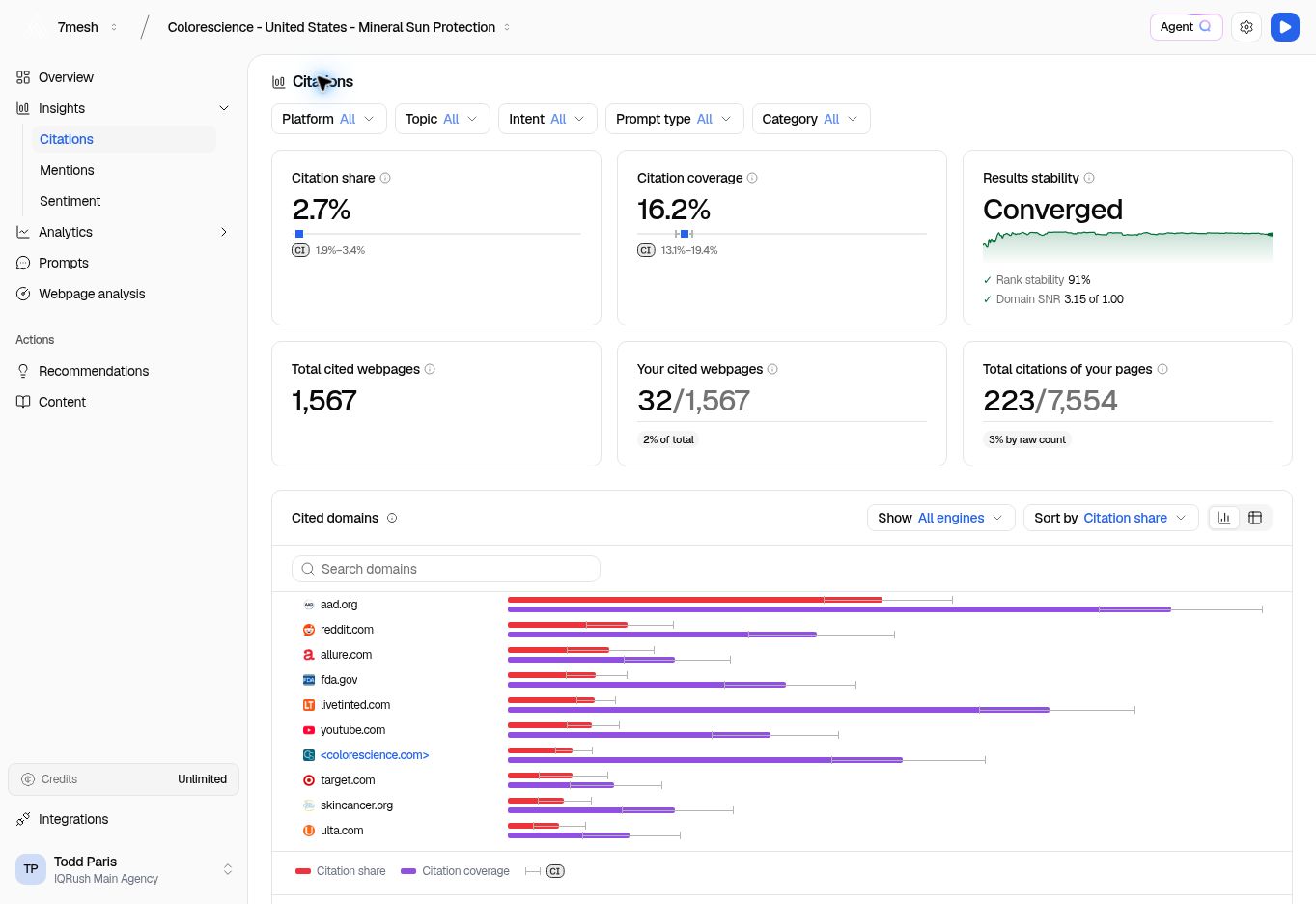
Start with **Overview** to see the main findings. Then open **Insights → Citations** to check the measurement behind them.
IQRush’s goal is **decision-grade measurement**: enough relevant evidence, with enough stability and precision, to support the decision you need to make. That requires more than a visible score or a completed run.
 ## Read the main measures
| Measure | Plain meaning |
| - | - |
| **Citation share** | Your website’s share of citation activity among the sources in the measured answers. |
| **Citation coverage** | The percentage of measured responses that cite the domain’s pages at least once. |
| **Mention count** | The number of recorded mentions of the selected brand or entity. A response can contain more than one mention. |
| **Mention coverage** | The percentage of measured responses that mention the selected brand or entity at least once. |
| **Net sentiment** | Positive share minus negative share among the analyzed mentions. Higher values mean more positive framing overall. |
| **Results stability** | Whether the citation ranking has both settled and become sufficiently distinguishable from measurement noise. |
A **response** is an answer to a prompt. It can contain several **statements**, mentions, and citations. A mention names a brand or another entity; a citation points to a source. An answer can mention your brand without citing your website.
## Understand coverage with a simple example
For one platform and one selected set of six measured responses:
| What happened | Coverage |
| - | - |
| Three responses cite your website at least once. | **50% citation coverage** |
| Three responses mention your brand at least once. | **50% mention coverage** |
Each response counts once for that coverage measure, even if it contains several qualifying citations or mentions. Coverage is counted across responses, not across the individual statements within them. The responses that mention you need not be the same ones that cite your website.
Combined platform views summarize platform results, so do not recreate their percentages by simply dividing pooled counts. Select one **Platform** when you want to inspect its coverage directly.
## Check stability and signal-to-noise together
AI answers can vary from one response to another. With too little evidence, a ranking can move as more responses are collected, or appear settled while the differences remain too uncertain to interpret.
The **Results stability** card brings two checks together:
| Reading | What it tells you |
| - | - |
| **Rank stability** | Whether the ordering of the measured sources has stopped moving materially as responses accumulate. The curve helps show whether it has settled. |
| **Domain SNR** | Whether the differences among the measured domains are strong enough relative to measurement noise. SNR means **signal-to-noise ratio**. |
| **Converged / Not converged** | Whether both checks have passed for the assessed result. |
The displayed SNR target is **1.00**. Below it, there is insufficient separation from noise for the ranking assessment. At or above it, that sufficiency check can pass; the rank-stability check must also pass. SNR is a ratio, not a percentage or a measure of improvement in your brand’s visibility.
In the screenshot, **91% Rank stability** is not “91% accuracy,” and **3.15 Domain SNR** is not “315% confidence.” The useful conclusion is the displayed **Converged** assessment. A high rank-stability percentage by itself is not enough.
Apply the assessment to the run and scope it describes. It does not certify every individual rank, filtered subgroup, sentiment result, or future answer. Use the uncertainty shown for the particular result you are acting on.
## Always read the confidence interval
A **confidence interval**, shown as **CI**, expresses uncertainty around an estimate. The **95% CI** gives a range consistent with the measured evidence under the analysis. Wider intervals mean less precision; a missing interval means you should not assume precision.
Confidence intervals are essential when deciding whether a change reflects normal variation in AI answers or a meaningful measured difference. In **Trend analysis**, read the interval and the change assessment together. A plus or minus sign alone is not enough to justify action.
**No significant change** means the comparison does not establish a clear change beyond its uncertainty. It does not prove the results are identical. For a result identified as significant, also ask whether the size of the change matters to your business.
## Before you act
1. Confirm the project, run, metric, and filters.
2. Check that the prompt set fits the question you intended to measure.
3. Read **Results stability**, including **Rank stability** and **Domain SNR**.
4. Read the relevant confidence interval and any change assessment.
5. Inspect the supporting answers or sources, then choose a proportionate action.
A **Not converged** result can still help you explore questions and sources. Treat close rankings as provisional and investigate the measurement before committing resources on their strength. A blank value or dash is not automatically zero.
## Ask about the evidence
“Is this run stable enough to compare cited domains? Explain rank stability and Domain SNR in plain English.”
Use Agent Q beside the page, or name the project, run, and filters in connected ChatGPT or Claude. See more [questions and reports](/guides/31-questions-and-reports).
**Next:** [Review citations](/guides/07-citations) or [compare runs](/guides/11-trends).
This documentation is built and hosted on [Mintlify](https://mintlify.com), a developer documentation platform.
## Read the main measures
| Measure | Plain meaning |
| - | - |
| **Citation share** | Your website’s share of citation activity among the sources in the measured answers. |
| **Citation coverage** | The percentage of measured responses that cite the domain’s pages at least once. |
| **Mention count** | The number of recorded mentions of the selected brand or entity. A response can contain more than one mention. |
| **Mention coverage** | The percentage of measured responses that mention the selected brand or entity at least once. |
| **Net sentiment** | Positive share minus negative share among the analyzed mentions. Higher values mean more positive framing overall. |
| **Results stability** | Whether the citation ranking has both settled and become sufficiently distinguishable from measurement noise. |
A **response** is an answer to a prompt. It can contain several **statements**, mentions, and citations. A mention names a brand or another entity; a citation points to a source. An answer can mention your brand without citing your website.
## Understand coverage with a simple example
For one platform and one selected set of six measured responses:
| What happened | Coverage |
| - | - |
| Three responses cite your website at least once. | **50% citation coverage** |
| Three responses mention your brand at least once. | **50% mention coverage** |
Each response counts once for that coverage measure, even if it contains several qualifying citations or mentions. Coverage is counted across responses, not across the individual statements within them. The responses that mention you need not be the same ones that cite your website.
Combined platform views summarize platform results, so do not recreate their percentages by simply dividing pooled counts. Select one **Platform** when you want to inspect its coverage directly.
## Check stability and signal-to-noise together
AI answers can vary from one response to another. With too little evidence, a ranking can move as more responses are collected, or appear settled while the differences remain too uncertain to interpret.
The **Results stability** card brings two checks together:
| Reading | What it tells you |
| - | - |
| **Rank stability** | Whether the ordering of the measured sources has stopped moving materially as responses accumulate. The curve helps show whether it has settled. |
| **Domain SNR** | Whether the differences among the measured domains are strong enough relative to measurement noise. SNR means **signal-to-noise ratio**. |
| **Converged / Not converged** | Whether both checks have passed for the assessed result. |
The displayed SNR target is **1.00**. Below it, there is insufficient separation from noise for the ranking assessment. At or above it, that sufficiency check can pass; the rank-stability check must also pass. SNR is a ratio, not a percentage or a measure of improvement in your brand’s visibility.
In the screenshot, **91% Rank stability** is not “91% accuracy,” and **3.15 Domain SNR** is not “315% confidence.” The useful conclusion is the displayed **Converged** assessment. A high rank-stability percentage by itself is not enough.
Apply the assessment to the run and scope it describes. It does not certify every individual rank, filtered subgroup, sentiment result, or future answer. Use the uncertainty shown for the particular result you are acting on.
## Always read the confidence interval
A **confidence interval**, shown as **CI**, expresses uncertainty around an estimate. The **95% CI** gives a range consistent with the measured evidence under the analysis. Wider intervals mean less precision; a missing interval means you should not assume precision.
Confidence intervals are essential when deciding whether a change reflects normal variation in AI answers or a meaningful measured difference. In **Trend analysis**, read the interval and the change assessment together. A plus or minus sign alone is not enough to justify action.
**No significant change** means the comparison does not establish a clear change beyond its uncertainty. It does not prove the results are identical. For a result identified as significant, also ask whether the size of the change matters to your business.
## Before you act
1. Confirm the project, run, metric, and filters.
2. Check that the prompt set fits the question you intended to measure.
3. Read **Results stability**, including **Rank stability** and **Domain SNR**.
4. Read the relevant confidence interval and any change assessment.
5. Inspect the supporting answers or sources, then choose a proportionate action.
A **Not converged** result can still help you explore questions and sources. Treat close rankings as provisional and investigate the measurement before committing resources on their strength. A blank value or dash is not automatically zero.
## Ask about the evidence
“Is this run stable enough to compare cited domains? Explain rank stability and Domain SNR in plain English.”
Use Agent Q beside the page, or name the project, run, and filters in connected ChatGPT or Claude. See more [questions and reports](/guides/31-questions-and-reports).
**Next:** [Review citations](/guides/07-citations) or [compare runs](/guides/11-trends).
This documentation is built and hosted on [Mintlify](https://mintlify.com), a developer documentation platform.